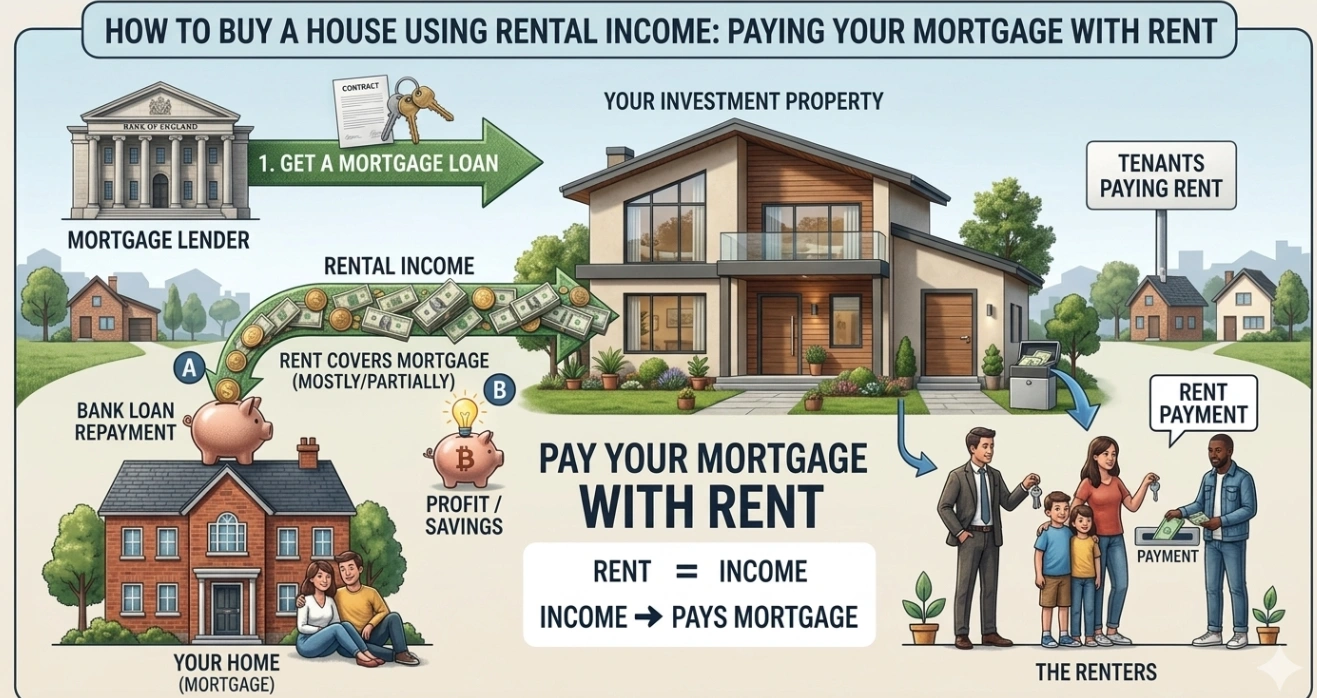
How to Buy a House Using Rental Income: Paying Your Mortgage With Rent | Buying a house is one of the biggest financial goals for many people. The challenge is that a mortgage can create a significant monthly expense for years.
One strategy that can make home ownership more manageable is to purchase a property that can generate rental income. Instead of relying entirely on your salary to pay the mortgage, you can use rent collected from tenants to cover part or even most of the monthly mortgage payment.
This strategy is often described as rent-to-pay-the-mortgage, but it requires careful calculations. Rental income is not guaranteed, and property ownership comes with taxes, maintenance, vacancies, and other expenses.
The key is to choose a property where the expected rental income is strong enough to support the overall cost.
How Does the Strategy Work?
The basic concept is straightforward.
You purchase a house or property using a mortgage, then rent it to tenants. Each month, the tenant pays rent, and that rental income is used to help pay the mortgage installment.
For example:
- Monthly mortgage payment: $500
- Monthly rental income: $650
- Property expenses: $100
- Remaining cash flow: $50
In this simplified example, the rental income covers the mortgage while also leaving a small amount after expenses.
The actual numbers can vary considerably depending on the property, financing terms, location, rental demand, and operating costs.
Step 1: Determine Your Maximum Mortgage Payment
Before looking for a property, calculate how much debt you can realistically handle.
Do not assume that the entire rental payment will be available for the mortgage.
A safer calculation should consider:
Rental income − operating expenses − vacancy reserve = available income for mortgage payments
For example, if a property could generate $700 per month in rent, you might not want to assume that the entire $700 is available for the mortgage.
Some of the money may need to cover:
- Maintenance
- Property taxes
- Insurance
- Repairs
- Management fees
- Utilities
- Vacancy periods
This produces a more realistic estimate of how much rent can actually contribute toward the mortgage.
Step 2: Choose a Location With Strong Rental Demand
Location is one of the most important factors in a rental property strategy.
A cheap house is not necessarily a good investment if it is difficult to find tenants.
Look for areas with consistent demand from:
- Employees
- Students
- Families
- Young professionals
- Factory workers
- Healthcare workers
- University communities
Properties near transportation, schools, shopping areas, offices, hospitals, and other essential facilities can often attract more potential tenants.
The goal is not simply to buy an inexpensive property. The goal is to buy a property that people actually want to rent.
Step 3: Calculate the Expected Rental Income
Research rental prices for similar properties in the same area.
Compare properties with similar:
- Size
- Number of bedrooms
- Location
- Facilities
- Parking
- Condition
- Furnishings
Avoid basing your calculation on the highest rental price you find.
A conservative estimate is usually better because your actual rental income may be lower than expected.
For example, if similar houses rent for between $500 and $600 per month, using $550 as a planning estimate may be more realistic than assuming you can consistently charge $600.
Step 4: Calculate the Mortgage
Next, calculate the expected mortgage installment.
The monthly payment depends on factors such as:
- Property price
- Down payment
- Loan amount
- Interest rate
- Loan duration
- Financing structure
A larger down payment can reduce the monthly mortgage burden.
However, putting too much money into the property can leave you without enough cash for emergencies, repairs, or vacancies.
The objective is to find a balance between an affordable loan and sufficient financial reserves.
Step 5: Calculate the Real Cash Flow
This is one of the most important steps.
Do not compare rent directly with the mortgage payment.
Instead, calculate the property’s estimated cash flow.
Suppose you purchase a house with the following monthly figures:
Rental income: $700
Mortgage payment: $500
Maintenance reserve: $50
Insurance and taxes: $50
Vacancy reserve: $50
Your estimated remaining cash flow would be:
$700 − $500 − $50 − $50 − $50 = $50
The property would generate approximately $50 in monthly cash flow under these assumptions.
The amount may seem small, but the property may also be building equity as the mortgage principal is gradually paid down.
Step 6: Prepare for Vacant Months
One of the biggest mistakes new rental-property owners make is assuming that the property will always have a tenant.
In reality, tenants can move out.
There may be periods when the property is empty while you search for a new tenant, repaint the rooms, repair damaged facilities, or advertise the property.
For this reason, create a vacancy reserve.
Instead of spending every dollar of rental income, keep part of it in a separate savings account.
This reserve can help cover mortgage payments during periods without rental income.
Step 7: Keep a Repair Fund
Every property eventually requires maintenance.
A leaking roof, damaged plumbing, broken appliances, electrical problems, or air-conditioning repairs can quickly become expensive.
A good rental-property strategy should therefore include a maintenance reserve.
Even if the house is new, setting aside money every month can prevent a single major repair from damaging your personal finances.
Step 8: Consider Different Rental Models
You do not necessarily have to rent the entire property to one family.
Depending on the location and property layout, several rental models may be possible.
Long-Term Rental
You rent the entire property to one tenant or family for an extended period.
This model can provide relatively predictable income and lower management demands.
Room Rental
A larger property can sometimes be divided into individual rooms for multiple tenants.
This may produce higher total rental income, but it can also increase management responsibilities.
Short-Term Rental
Properties in tourist areas may be suitable for short-term accommodation.
However, this model can involve greater operational costs, cleaning, marketing, and regulation.
Choose the model that fits the property and local market rather than simply choosing the option with the highest theoretical income.
Step 9: Keep Personal and Property Finances Separate
A separate account for rental income and expenses can make financial management much easier.
You can use it to track:
- Rental payments
- Mortgage installments
- Maintenance
- Insurance
- Taxes
- Property improvements
- Management costs
Keeping records also makes it easier to determine whether the property is genuinely profitable.
Step 10: Do Not Ignore Your Own Income
Rental income should not be viewed as a substitute for financial stability.
Banks may also evaluate your employment income, credit profile, existing debt, and ability to make mortgage payments when you apply for financing.
Even if you expect rent to cover the mortgage, you should be financially prepared to make payments yourself if the property becomes vacant.
This is especially important during the first few years of ownership.
The Importance of a Financial Safety Margin
A strong rental property does not have to produce enormous monthly profits.
What matters is whether the numbers remain manageable when conditions are less favorable.
For example, imagine that the property generates $700 in rent but the mortgage and operating costs total $650.
The $50 difference is a relatively small margin.
If the property becomes vacant for one month, however, you could immediately face a significant shortfall.
A stronger investment may have enough rental income to cover expenses while leaving a meaningful safety margin.
Common Mistakes to Avoid
Buying Based Only on Cheap Property Prices
A cheap house in an area with weak rental demand can become an expensive mistake.
Assuming 100% Occupancy
Tenants will eventually leave. Vacancy should always be included in your calculations.
Ignoring Maintenance
Repairs are part of property ownership. They should be treated as a normal operating expense.
Using All Savings for the Down Payment
A property purchase should not leave you with no emergency funds.
Chasing the Highest Possible Rent
An unrealistic rental price can result in long vacancy periods.
Forgetting Legal and Tax Obligations
Rental properties may involve taxes, permits, contracts, insurance requirements, and other local regulations.
When Does This Strategy Make Sense?
Buying a property and using rental income to help pay the mortgage can make sense when several conditions are present:
- Rental demand is strong.
- The purchase price is reasonable.
- The mortgage payment is manageable.
- Rental income comfortably covers a large portion of operating costs.
- You have an emergency reserve.
- You understand the responsibilities of being a landlord.
If the numbers only work under perfect conditions, the investment may be too risky.
Using rental income to help pay a mortgage can be an effective path toward property ownership, but it should never be treated as effortless or guaranteed.
The most important step is to calculate the complete financial picture. Consider rent, mortgage payments, maintenance, taxes, insurance, vacancies, and unexpected repairs before deciding whether a property is affordable.
A successful rental property strategy is built on realistic numbers rather than optimistic assumptions.
If you choose the right location, purchase at a sensible price, maintain adequate reserves, and manage the property carefully, rental income can help reduce the personal burden of mortgage payments while the property gradually builds long-term value.