
How to Calculate Your Affordable Mortgage With an IDR 4 Million Salary
How to Calculate Your Affordable Mortgage With an IDR 4 Million Salary | Buying a home is an important financial goal, but it can feel challenging when your monthly income is limited. If you earn IDR 4 million per month, understanding your affordable mortgage payment is essential before choosing a property.

The key is to avoid focusing only on the maximum loan offered by a bank. Instead, calculate a monthly payment that still leaves enough money for food, transportation, savings, emergencies, and other financial obligations.
How Much Mortgage Can You Afford?
A common starting point for calculating an affordable mortgage is to keep your monthly housing payment within a reasonable percentage of your income.
With a salary of IDR 4 million per month, allocating around 25% to 30% of monthly income toward a mortgage would mean approximately:
- 25% = IDR 1 million per month
- 30% = IDR 1.2 million per month
- 35% = IDR 1.4 million per month
For someone with a relatively modest income, targeting the lower end can provide more financial flexibility.
Therefore, a mortgage payment of around IDR 1 million to IDR 1.2 million per month may be a more comfortable starting range, depending on your other expenses and debts.
Consider Your Existing Debts
Your mortgage should not be calculated separately from your other financial obligations.
If you already have motorcycle financing, personal loans, credit-card payments, or other installments, adding a mortgage could put significant pressure on your monthly cash flow.
For example, suppose your IDR 4 million salary is divided as follows:
| Monthly Expense | Example Amount |
|---|---|
| Daily living expenses | IDR 2,000,000 |
| Existing debt payments | IDR 400,000 |
| Savings and emergency fund | IDR 400,000 |
| Mortgage payment | IDR 1,000,000 |
| Other expenses | IDR 200,000 |
| Total | IDR 4,000,000 |
This is only an example. Your actual budget should reflect your household situation, transportation costs, dependents, and existing financial commitments.
Don’t Forget the Down Payment
Your monthly mortgage payment is only one part of the cost of buying a home.
You may also need money for the down payment, taxes, administrative costs, insurance, notary fees, and other transaction expenses.
Saving for the down payment before applying for a mortgage can make the loan more manageable.
For example, if you want to buy a property priced at IDR 200 million and have a 10% down payment requirement, you would need around IDR 20 million for the down payment alone.
The actual amount depends on the mortgage program, lender, property, and applicable terms.
Estimate Your Home Price Carefully
A useful approach is to work backward from the monthly payment you can afford.
If your comfortable mortgage budget is approximately IDR 1 million per month, look for properties and loan terms that keep the estimated installment around that amount.
Avoid choosing a house based solely on the maximum property price you can technically finance.
A bank may approve a loan that is larger than what is comfortable for your everyday budget.
Example Mortgage Calculation
Imagine you want to purchase a home worth IDR 200 million.
If you make a hypothetical IDR 20 million down payment, the remaining loan would be IDR 180 million.
The actual monthly installment would depend on factors such as:
- Mortgage interest rate
- Loan term
- Down payment
- Fixed or floating interest structure
- Bank fees and insurance
- Loan eligibility
For this reason, a mortgage calculator or official bank simulation should be used before making a final decision.
The numbers in this example are for illustration and are not a guaranteed mortgage offer.
A Longer Loan Term Can Lower Monthly Payments
One way to reduce monthly installments is to choose a longer mortgage term.
However, a longer loan period generally means you may pay more interest over the entire life of the mortgage.
For someone earning IDR 4 million per month, it can be tempting to choose the longest possible term simply to obtain a lower installment.
Instead, compare both the monthly payment and the total amount you will repay.
A slightly higher payment may be worthwhile if it significantly reduces the overall interest cost, provided the payment remains affordable.
Build an Emergency Fund First
Before committing to a long-term mortgage, make sure you have some emergency savings.
Homeowners may face unexpected expenses such as repairs, medical bills, job interruptions, or increases in everyday living costs.
Without an emergency fund, an unexpected expense could make it difficult to maintain mortgage payments.
Even if you cannot save a large amount immediately, developing a consistent savings habit can improve your financial stability.
Can You Buy a House With an IDR 4 Million Salary?
Yes, it may be possible, but affordability depends on more than salary alone.
Your chances of comfortably purchasing a home can improve if you:
- Have minimal existing debt
- Maintain stable employment
- Save for a larger down payment
- Choose an affordable property
- Have additional household income
- Maintain an emergency fund
- Compare different mortgage options
If you are buying a home with a spouse or family member, combined income may also affect the amount you can potentially borrow.
However, the goal should remain affordability rather than borrowing the maximum amount available.
Practical Tips for First-Time Home Buyers
If you earn IDR 4 million per month and are planning to buy your first home, start with your household budget rather than property listings.
Write down your income and essential expenses. Then determine how much money you can consistently allocate toward housing without sacrificing basic needs and savings.
It can also help to save a dedicated home-buying fund. Keeping the down payment and transaction costs separate from your emergency savings can prevent you from starting homeownership with no financial cushion.
Most importantly, compare mortgage offers carefully and read the terms before signing any agreement.
With a IDR 4 million monthly salary, buying a home requires careful planning and realistic expectations.
A mortgage payment of around IDR 1 million to IDR 1.2 million per month can serve as an initial budgeting range, but the appropriate amount depends on your debts, living costs, savings, household income, interest rate, and loan term.
The best mortgage is not necessarily the largest loan a bank will approve. It is a mortgage that allows you to own a home while still having enough money to live comfortably, save for emergencies, and handle unexpected expenses.
Before applying, calculate your complete monthly budget, prepare for the down payment and additional costs, and use current lender calculations to determine the actual mortgage payment you can afford.
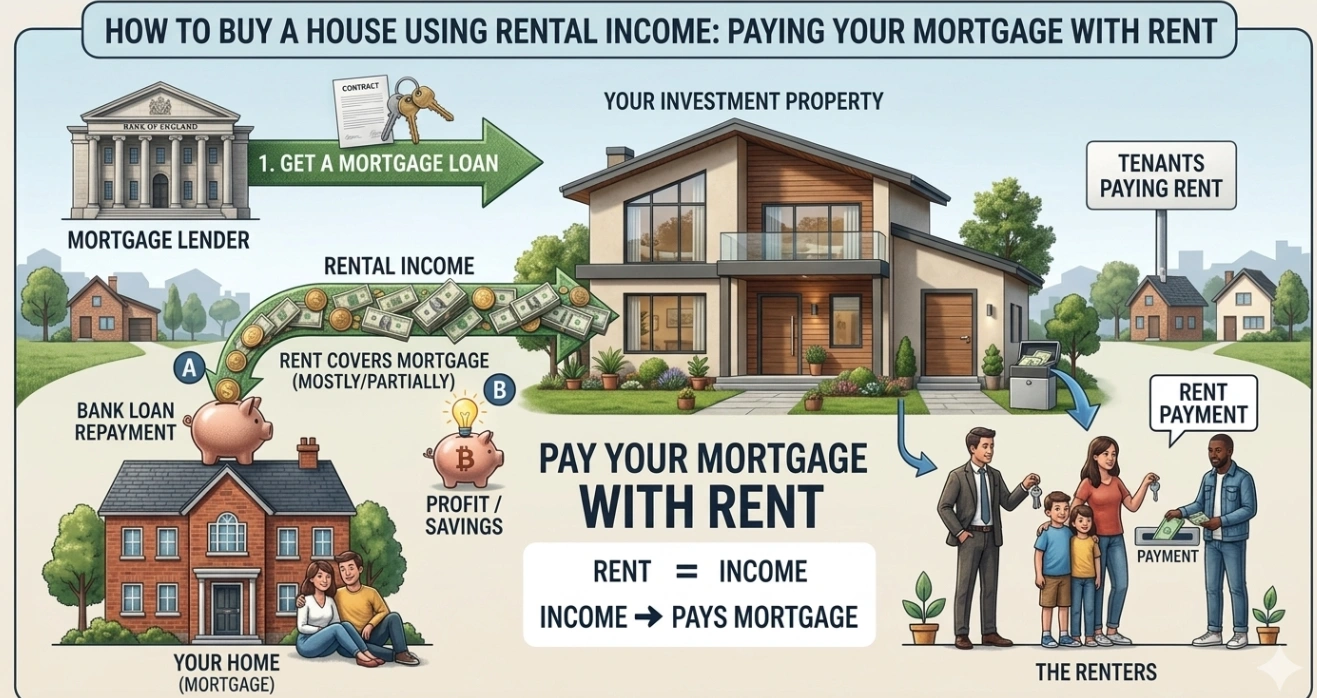
How to Buy a House Using Rental Income: Paying Your Mortgage With Rent
How to Buy a House Using Rental Income: Paying Your Mortgage With Rent | Buying a house is one of the biggest financial goals for many people. The challenge is that a mortgage can create a significant monthly expense for years.

One strategy that can make home ownership more manageable is to purchase a property that can generate rental income. Instead of relying entirely on your salary to pay the mortgage, you can use rent collected from tenants to cover part or even most of the monthly mortgage payment.
This strategy is often described as rent-to-pay-the-mortgage, but it requires careful calculations. Rental income is not guaranteed, and property ownership comes with taxes, maintenance, vacancies, and other expenses.
The key is to choose a property where the expected rental income is strong enough to support the overall cost.
How Does the Strategy Work?
The basic concept is straightforward.
You purchase a house or property using a mortgage, then rent it to tenants. Each month, the tenant pays rent, and that rental income is used to help pay the mortgage installment.
For example:
- Monthly mortgage payment: $500
- Monthly rental income: $650
- Property expenses: $100
- Remaining cash flow: $50
In this simplified example, the rental income covers the mortgage while also leaving a small amount after expenses.
The actual numbers can vary considerably depending on the property, financing terms, location, rental demand, and operating costs.
Step 1: Determine Your Maximum Mortgage Payment
Before looking for a property, calculate how much debt you can realistically handle.
Do not assume that the entire rental payment will be available for the mortgage.
A safer calculation should consider:
Rental income − operating expenses − vacancy reserve = available income for mortgage payments
For example, if a property could generate $700 per month in rent, you might not want to assume that the entire $700 is available for the mortgage.
Some of the money may need to cover:
- Maintenance
- Property taxes
- Insurance
- Repairs
- Management fees
- Utilities
- Vacancy periods
This produces a more realistic estimate of how much rent can actually contribute toward the mortgage.
Step 2: Choose a Location With Strong Rental Demand
Location is one of the most important factors in a rental property strategy.
A cheap house is not necessarily a good investment if it is difficult to find tenants.
Look for areas with consistent demand from:
- Employees
- Students
- Families
- Young professionals
- Factory workers
- Healthcare workers
- University communities
Properties near transportation, schools, shopping areas, offices, hospitals, and other essential facilities can often attract more potential tenants.
The goal is not simply to buy an inexpensive property. The goal is to buy a property that people actually want to rent.
Step 3: Calculate the Expected Rental Income
Research rental prices for similar properties in the same area.
Compare properties with similar:
- Size
- Number of bedrooms
- Location
- Facilities
- Parking
- Condition
- Furnishings
Avoid basing your calculation on the highest rental price you find.
A conservative estimate is usually better because your actual rental income may be lower than expected.
For example, if similar houses rent for between $500 and $600 per month, using $550 as a planning estimate may be more realistic than assuming you can consistently charge $600.
Step 4: Calculate the Mortgage
Next, calculate the expected mortgage installment.
The monthly payment depends on factors such as:
- Property price
- Down payment
- Loan amount
- Interest rate
- Loan duration
- Financing structure
A larger down payment can reduce the monthly mortgage burden.
However, putting too much money into the property can leave you without enough cash for emergencies, repairs, or vacancies.
The objective is to find a balance between an affordable loan and sufficient financial reserves.
Step 5: Calculate the Real Cash Flow
This is one of the most important steps.
Do not compare rent directly with the mortgage payment.
Instead, calculate the property’s estimated cash flow.
Suppose you purchase a house with the following monthly figures:
Rental income: $700
Mortgage payment: $500
Maintenance reserve: $50
Insurance and taxes: $50
Vacancy reserve: $50
Your estimated remaining cash flow would be:
$700 − $500 − $50 − $50 − $50 = $50
The property would generate approximately $50 in monthly cash flow under these assumptions.
The amount may seem small, but the property may also be building equity as the mortgage principal is gradually paid down.
Step 6: Prepare for Vacant Months
One of the biggest mistakes new rental-property owners make is assuming that the property will always have a tenant.
In reality, tenants can move out.
There may be periods when the property is empty while you search for a new tenant, repaint the rooms, repair damaged facilities, or advertise the property.
For this reason, create a vacancy reserve.
Instead of spending every dollar of rental income, keep part of it in a separate savings account.
This reserve can help cover mortgage payments during periods without rental income.
Step 7: Keep a Repair Fund
Every property eventually requires maintenance.
A leaking roof, damaged plumbing, broken appliances, electrical problems, or air-conditioning repairs can quickly become expensive.
A good rental-property strategy should therefore include a maintenance reserve.
Even if the house is new, setting aside money every month can prevent a single major repair from damaging your personal finances.
Step 8: Consider Different Rental Models
You do not necessarily have to rent the entire property to one family.
Depending on the location and property layout, several rental models may be possible.
Long-Term Rental
You rent the entire property to one tenant or family for an extended period.
This model can provide relatively predictable income and lower management demands.
Room Rental
A larger property can sometimes be divided into individual rooms for multiple tenants.
This may produce higher total rental income, but it can also increase management responsibilities.
Short-Term Rental
Properties in tourist areas may be suitable for short-term accommodation.
However, this model can involve greater operational costs, cleaning, marketing, and regulation.
Choose the model that fits the property and local market rather than simply choosing the option with the highest theoretical income.
Step 9: Keep Personal and Property Finances Separate
A separate account for rental income and expenses can make financial management much easier.
You can use it to track:
- Rental payments
- Mortgage installments
- Maintenance
- Insurance
- Taxes
- Property improvements
- Management costs
Keeping records also makes it easier to determine whether the property is genuinely profitable.
Step 10: Do Not Ignore Your Own Income
Rental income should not be viewed as a substitute for financial stability.
Banks may also evaluate your employment income, credit profile, existing debt, and ability to make mortgage payments when you apply for financing.
Even if you expect rent to cover the mortgage, you should be financially prepared to make payments yourself if the property becomes vacant.
This is especially important during the first few years of ownership.
The Importance of a Financial Safety Margin
A strong rental property does not have to produce enormous monthly profits.
What matters is whether the numbers remain manageable when conditions are less favorable.
For example, imagine that the property generates $700 in rent but the mortgage and operating costs total $650.
The $50 difference is a relatively small margin.
If the property becomes vacant for one month, however, you could immediately face a significant shortfall.
A stronger investment may have enough rental income to cover expenses while leaving a meaningful safety margin.
Common Mistakes to Avoid
Buying Based Only on Cheap Property Prices
A cheap house in an area with weak rental demand can become an expensive mistake.
Assuming 100% Occupancy
Tenants will eventually leave. Vacancy should always be included in your calculations.
Ignoring Maintenance
Repairs are part of property ownership. They should be treated as a normal operating expense.
Using All Savings for the Down Payment
A property purchase should not leave you with no emergency funds.
Chasing the Highest Possible Rent
An unrealistic rental price can result in long vacancy periods.
Forgetting Legal and Tax Obligations
Rental properties may involve taxes, permits, contracts, insurance requirements, and other local regulations.
When Does This Strategy Make Sense?
Buying a property and using rental income to help pay the mortgage can make sense when several conditions are present:
- Rental demand is strong.
- The purchase price is reasonable.
- The mortgage payment is manageable.
- Rental income comfortably covers a large portion of operating costs.
- You have an emergency reserve.
- You understand the responsibilities of being a landlord.
If the numbers only work under perfect conditions, the investment may be too risky.
Using rental income to help pay a mortgage can be an effective path toward property ownership, but it should never be treated as effortless or guaranteed.
The most important step is to calculate the complete financial picture. Consider rent, mortgage payments, maintenance, taxes, insurance, vacancies, and unexpected repairs before deciding whether a property is affordable.
A successful rental property strategy is built on realistic numbers rather than optimistic assumptions.
If you choose the right location, purchase at a sensible price, maintain adequate reserves, and manage the property carefully, rental income can help reduce the personal burden of mortgage payments while the property gradually builds long-term value.
Saving for a Home While Supporting Your Family: Can You Afford the Mortgage
Saving for a Home While Supporting Your Family: Can You Afford the Mortgage | Buying a home is one of the biggest financial decisions many families will make. But for people who are also supporting parents, children, siblings, or other relatives, saving for a home can become significantly more complicated.

A mortgage payment is only one part of the cost of homeownership. You also need to consider your down payment, closing costs, property taxes, insurance, maintenance, utilities, and unexpected repairs. At the same time, your family may depend on you for regular financial support.
So, can you afford a mortgage while supporting your family?
The answer depends less on how much a lender says you can borrow and more on whether the monthly payment fits comfortably into your real household budget.
Start With Your Complete Monthly Budget
Before looking at homes, calculate how much money actually comes into your household each month and where it goes.
Start with your reliable after-tax income. Then list your essential expenses, including:
- Rent or current housing costs
- Food and groceries
- Utilities
- Transportation
- Health and insurance costs
- Childcare or education
- Debt payments
- Family support
- Subscriptions and other recurring expenses
- Savings and emergency contributions
Do not leave out financial support for family members simply because it is not a formal bill.
If you regularly send money to your parents or help a relative pay for medical expenses, education, rent, or other necessities, that money is part of your real monthly financial obligations.
How Much Family Support Do You Provide?
Family support can vary significantly from month to month.
Some households provide a fixed amount every month. Others cover expenses only when a family member needs help.
If your support is inconsistent, look at your spending history over the previous 6 to 12 months. Calculate the average amount and identify the largest unexpected payments.
This gives you a more realistic picture of your financial responsibilities.
For example, suppose your household brings home $7,000 per month and you regularly provide $800 to family members.
Your effective available income is not the same as that of a household earning $7,000 with no family-support obligations.
That difference matters when determining how much housing you can comfortably afford.
Don’t Use the Lender’s Maximum as Your Target
Mortgage lenders evaluate your finances using specific qualification criteria. However, being approved for a mortgage does not necessarily mean the payment will feel comfortable.
A lender may determine that you qualify for a certain loan amount based on your income, debts, credit history, and other factors.
Your personal budget has additional considerations.
You may need to continue helping family members. You may want to maintain retirement contributions. You may have children whose expenses will increase over time.
For this reason, think of mortgage approval as a maximum borrowing limit, not a recommended spending target.
Calculate the Real Cost of Homeownership
When estimating a mortgage payment, avoid focusing only on principal and interest.
Your total monthly housing cost may also include:
Property Taxes
Property taxes can add a significant amount to your monthly housing expenses depending on where you live and the value of the property.
Homeowners Insurance
Insurance is another recurring cost that should be included in your budget.
Mortgage Insurance
Depending on your loan structure and down payment, you may have to pay mortgage insurance.
Maintenance
Every home requires maintenance.
A broken water heater, damaged roof, plumbing issue, or appliance replacement can create a large unexpected expense.
Utilities
Homeownership can also change your electricity, water, heating, cooling, and other utility costs.
A house that looks affordable based on its mortgage payment alone may become much more expensive after all these costs are included.
Build an Emergency Fund Before Buying
An emergency fund becomes especially important when you are responsible for other people financially.
Homeownership can introduce unexpected expenses at exactly the wrong time.
Before purchasing a home, consider whether you have enough cash reserves to handle both household emergencies and potential home repairs.
Your emergency fund should be separate from the money you plan to use for your down payment and closing costs.
Using every dollar of savings to purchase the home can leave you financially vulnerable immediately after closing.
Don’t Sacrifice Family Support to Become a Homeowner
Homeownership is an important goal, but it should not automatically take priority over essential family responsibilities.
If your parents, children, or other relatives depend on your financial support, reducing that support dramatically may create problems elsewhere.
Instead, calculate your housing budget around the responsibilities you expect to continue.
This approach may mean buying a smaller home, choosing a different neighborhood, increasing your down payment, or waiting longer before purchasing.
There is nothing wrong with adjusting your home-buying timeline to protect your overall financial stability.
Consider Your Future Income and Expenses
Your current budget is important, but your future budget matters too.
Think about what could change over the next five to ten years.
Will your children enter college?
Could your parents require more financial assistance?
Are you planning to change jobs?
Could your income decrease temporarily?
Will you have other major expenses?
A mortgage is a long-term commitment. A payment that looks manageable today may become difficult if several financial responsibilities increase at the same time.
What If You Are Supporting Elderly Parents?
Supporting aging parents can create unique financial challenges.
Medical expenses, housing costs, transportation, and daily care can increase as parents get older.
If you expect your parents to need additional support in the future, include a realistic estimate in your long-term housing plan.
You may also want to discuss financial expectations with family members before purchasing a home.
Clear communication can prevent misunderstandings later.
How Much Should You Save Before Buying?
There is no single savings amount that works for every household.
At a minimum, your home-buying savings plan should account for more than the down payment.
Consider setting aside money for:
- Down payment
- Closing costs
- Moving expenses
- Initial repairs
- Furniture or appliances
- Emergency savings
- Ongoing family support
The larger your financial responsibilities, the more important it may be to maintain a healthy cash reserve.
A Simple Affordability Test
One useful way to test whether you can afford a mortgage is to simulate the payment before buying.
If your future housing costs are expected to be $2,500 per month, start setting aside an additional amount each month while you are still renting.
If you can consistently save that amount without relying on credit cards, skipping family support, or reducing essential expenses, you may have stronger evidence that the payment is manageable.
If the simulated payment immediately creates financial stress, that is useful information too.
You may need a lower-priced home or more time to save.
What If You Are Already Supporting Your Family?
Family support does not automatically prevent you from buying a home.
The key is to treat it as part of the financial plan rather than an expense that disappears from your calculations.
Create two separate goals:
Homeownership goal: money needed for your down payment, closing costs, and reserves.
Family-support goal: money required to continue meeting your family’s needs.
Then build your monthly budget around both goals.
This approach provides a clearer picture of what you can actually afford.
Should You Wait to Buy a Home?
Sometimes waiting is the financially responsible choice.
Waiting can give you more time to increase your savings, reduce debt, improve your credit profile, or establish a larger emergency fund.
However, waiting also has potential trade-offs because home prices, mortgage rates, rent, and your personal circumstances can change.
The goal should not be to predict the perfect time to buy.
Instead, focus on whether your own finances are ready.
A Home Should Strengthen Your Finances, Not Break Them
A successful home purchase should fit into your life rather than force you to reorganize everything around the mortgage.
If purchasing a home means you can no longer support your family, stop saving for emergencies, or rely on credit to cover everyday expenses, the house may be too expensive.
On the other hand, if you can comfortably handle the mortgage while maintaining family support, savings, and other financial goals, homeownership may be a realistic next step.
Saving for a home while supporting your family requires more than calculating how large a mortgage you can qualify for.
You need to understand your complete household budget, including the financial support you provide to relatives. You also need to account for property taxes, insurance, maintenance, emergencies, and other costs that come with owning a home.
Most importantly, don’t confuse mortgage approval with affordability.
The right home is not necessarily the most expensive home a lender will approve. It is the home you can afford while still protecting your family’s financial security and your long-term goals.
Before signing a mortgage, take a realistic look at your income, expenses, savings, family responsibilities, and future plans.
A little extra planning today can help make homeownership a source of stability rather than financial stress.

Warren Buffett’s Principles for Making Smarter Home Financing Decisions
Warren Buffett’s Principles for Making Smarter Home Financing Decisions | Buying a home is one of the largest financial commitments most people will ever make. Whether you’re purchasing your first home or upgrading to a larger property, the decisions you make today can affect your financial future for decades. While Warren Buffett is widely recognized as one of the greatest investors of all time, his timeless financial philosophy offers valuable lessons that extend far beyond the stock market.

When it comes to homeownership, Buffett’s emphasis on patience, discipline, value, and risk management can help buyers avoid costly mistakes and make smarter borrowing decisions. Rather than chasing the biggest house or the lowest monthly payment without understanding the long-term impact, his principles encourage homeowners to focus on sustainable financial success.
In this guide, we’ll explore Warren Buffett’s principles for making smarter home financing decisions and show how these investment lessons can help you build wealth while owning a home.
Why Warren Buffett’s Financial Philosophy Matters for Homebuyers
Many people think of mortgages as simple monthly payments, but they’re actually long-term financial commitments that often last 15 to 30 years. A small decision made during the mortgage application process can result in thousands—or even tens of thousands—of dollars in additional costs over the life of the loan.
Warren Buffett has repeatedly emphasized making decisions based on long-term value instead of short-term excitement. Applying this mindset to home financing helps buyers avoid unnecessary debt, improve financial stability, and create lasting wealth.
Instead of asking, “How much house can I afford?” Buffett’s philosophy encourages a better question:
“How much home allows me to continue building wealth over the long term?”
That shift in perspective can completely change how buyers approach mortgages.
1. Never Borrow More Than You Truly Need
One of Buffett’s most consistent lessons is to avoid unnecessary risk. In investing, that means not putting too much money into uncertain opportunities. In home financing, it means resisting the temptation to borrow the maximum amount a lender is willing to approve.
Mortgage lenders determine how much you qualify for based on income, credit score, and debt. However, qualifying for a larger loan doesn’t necessarily mean it’s the right financial decision.
A mortgage that consumes too much of your monthly income can make it difficult to:
- Save for retirement
- Build an emergency fund
- Invest for the future
- Handle unexpected medical bills
- Cover home maintenance expenses
Choosing a more affordable home often creates greater financial freedom over time.
2. Think Long Term Instead of Following Market Hype
Real estate markets naturally rise and fall. During housing booms, buyers often feel pressure to purchase immediately out of fear of missing out.
Buffett has consistently warned investors against making emotional decisions driven by market excitement.
When purchasing a home, evaluate its long-term value rather than focusing solely on short-term price appreciation.
Consider factors such as:
- Neighborhood safety
- Quality of local schools
- Job market growth
- Infrastructure improvements
- Access to healthcare
- Transportation options
- Future development plans
Homes located in desirable areas often maintain their value better during market downturns.
3. Understand Every Mortgage Term Before Signing
Buffett famously avoids investing in businesses he doesn’t fully understand. The same principle applies to home financing.
Before signing mortgage documents, understand every detail of your loan, including:
- Interest rate
- APR (Annual Percentage Rate)
- Loan term
- Closing costs
- Origination fees
- Mortgage insurance
- Property taxes
- Homeowners insurance
- Prepayment penalties
- Adjustable-rate vs. fixed-rate mortgages
Many buyers focus only on the monthly payment, but understanding the total borrowing cost can prevent expensive surprises later.
4. Build a Strong Financial Safety Margin
One of Buffett’s favorite investing concepts is the “margin of safety.” This means preparing for uncertainty before problems arise.
Homeowners should maintain financial reserves that allow them to manage unexpected situations such as:
- Job loss
- Medical emergencies
- Major home repairs
- Economic downturns
- Rising living expenses
Financial experts commonly recommend maintaining several months of living expenses in an emergency fund before purchasing a home.
A strong financial cushion reduces stress and helps homeowners avoid relying on high-interest debt during difficult times.
5. Avoid Emotional Buying Decisions
Buying a dream home can be exciting, but emotions often lead buyers to spend more than they originally planned.
Buffett reminds investors that emotional decisions rarely produce the best financial outcomes.
Before making an offer, ask yourself:
- Can I comfortably afford this payment?
- Will I still be financially secure if interest rates change?
- Will I have money left for investing?
- Does this purchase support my long-term financial goals?
If the answer to any of these questions is “no,” waiting may be the wiser decision.
6. Keep Investing After Buying Your Home
Many homeowners make the mistake of directing every available dollar toward their mortgage while neglecting other financial priorities.
Although paying off debt is important, Buffett consistently encourages long-term investing.
After purchasing a home, continue building wealth by contributing to:
- Retirement accounts
- Emergency savings
- Diversified investment portfolios
- Education funds
- Health savings
A balanced financial strategy can provide greater long-term security than focusing exclusively on home equity.
7. Compare Mortgage Offers Carefully
Not all mortgages are the same.
Even a small difference in interest rates can save—or cost—you thousands of dollars over the life of a loan.
Before choosing a lender, compare:
- Interest rates
- Closing costs
- Customer service
- Loan flexibility
- Refinancing options
- Repayment terms
Taking time to compare offers is consistent with Buffett’s habit of conducting careful research before making any financial commitment.
8. Improve Your Credit Before Applying
A strong credit score often leads to lower interest rates, reducing the total cost of your mortgage.
Before applying, consider:
- Paying bills on time
- Reducing credit card balances
- Avoiding unnecessary new debt
- Checking your credit report for errors
Improving your credit profile before applying can produce significant long-term savings.
9. Buy a Home That Fits Your Lifestyle
A house should support your life—not create financial stress.
Instead of purchasing based on appearances or social expectations, choose a property that aligns with your actual needs.
Ask yourself:
- How long do I plan to live here?
- Is the location convenient?
- Can I comfortably afford maintenance?
- Will this home still meet my needs in five to ten years?
These practical questions often lead to smarter purchasing decisions.
10. Treat Your Home as Part of Your Overall Financial Plan
One of Buffett’s greatest strengths is viewing every financial decision within the context of a broader strategy.
Your mortgage should fit into your complete financial picture, including:
- Retirement planning
- Insurance coverage
- Emergency savings
- Investment goals
- Family expenses
- Future education costs
A home should strengthen your financial future rather than limit your opportunities.
Common Home Financing Mistakes to Avoid
Many buyers unknowingly make costly mistakes that Buffett’s philosophy would discourage.
Common examples include:
- Borrowing the maximum amount offered.
- Ignoring the total interest paid over the life of the loan.
- Choosing adjustable-rate mortgages without understanding the risks.
- Emptying savings for a larger down payment.
- Purchasing based on emotions instead of affordability.
- Failing to compare multiple lenders.
- Neglecting emergency savings after closing.
Avoiding these mistakes can significantly improve your long-term financial health.
Warren Buffett’s principles for making smarter home financing decisions are rooted in common sense, patience, and disciplined financial planning. Although he built his reputation through investing, the same ideas can help anyone become a more confident and financially responsible homeowner.
By borrowing only what you truly need, understanding every aspect of your mortgage, maintaining a healthy financial safety margin, and keeping your long-term goals in focus, you can make home financing decisions that support lasting financial success.
Remember that buying a home isn’t simply about owning property—it’s about creating a stable financial foundation for the future. Following Warren Buffett’s timeless principles can help you reduce risk, preserve financial flexibility, and build wealth for years to come.